Thursday, 17 March 2016

Preproduction Pipelines


A production pipeline is key to focusing the next steps to take within practical research. Below shows the beginning of each creature concept, the inkblots. After outlining the inkblot, development of design and anatomy will be undertaken until the creature is finished, then final evaluation. The steps within the design and anatomy process are charcoal sketches, development sketches, illustrative pieces, head close up, animal anatomy studies, creature anatomy studies, colour/fur variations, and then the final turnaround sheets. After the final design of each creature has been created, a final piece will be painted that shows that creature interacting with either its environment or other creatures of the same species.    


 Above are figures 1, 2 and 3 which show the development of the production pipeline itself. Figure 3 is the final pipeline; it shows each stage of the development of the creature designs. First section is the design of the creature, how it looks, how to socializes, raise their young and what kind of environment they live in. The anatomy section focuses on the study of real animals and creating a body that is well suited for that creature on the outcomes from the design. If the creature has not been developed to a high standard and does not make sense in terms of its body to its environment etc. the process will continue through the circle of design and anatomy until a well developed and believable creature has been created. The final stage is the creation of the final piece. A painting will be made showing a scene of that creature within its natural habitat. The scene could be of a mother and calf, creatures interacting with each other, or them hunting etc. After the completion of the final piece, a final evaluation will be completed which is a simple look over all the final development pieces of that creature to ensure that it can survive in its. If there is a problem and the creature does not fully suit its environment, the development pieces will be taken back to the design and anatomy parts of the production pipeline to work out the problem and to create a solution.

“Composition, decorative devices, colour scheme, and the characters themselves all combine to tell the story.” Terryl Whitlatch page 105

Overall, the production pipeline has been a success as none of the creatures had to be taken back into the design and anatomy stages during the final evaluation. The development of each creature went through the final production pipeline smoothly. Certain parts of the pipeline could be taken out such as the charcoal sketches as they did not add anything to the actual design, the development sketches is where the most exploration had taken place. To take its place within the design part of the pipeline, environmental sketches could give a clearer understanding of where each creature lives and how it adapts to it.

Wednesday, 16 March 2016

Creature 3: Illustrative Pieces

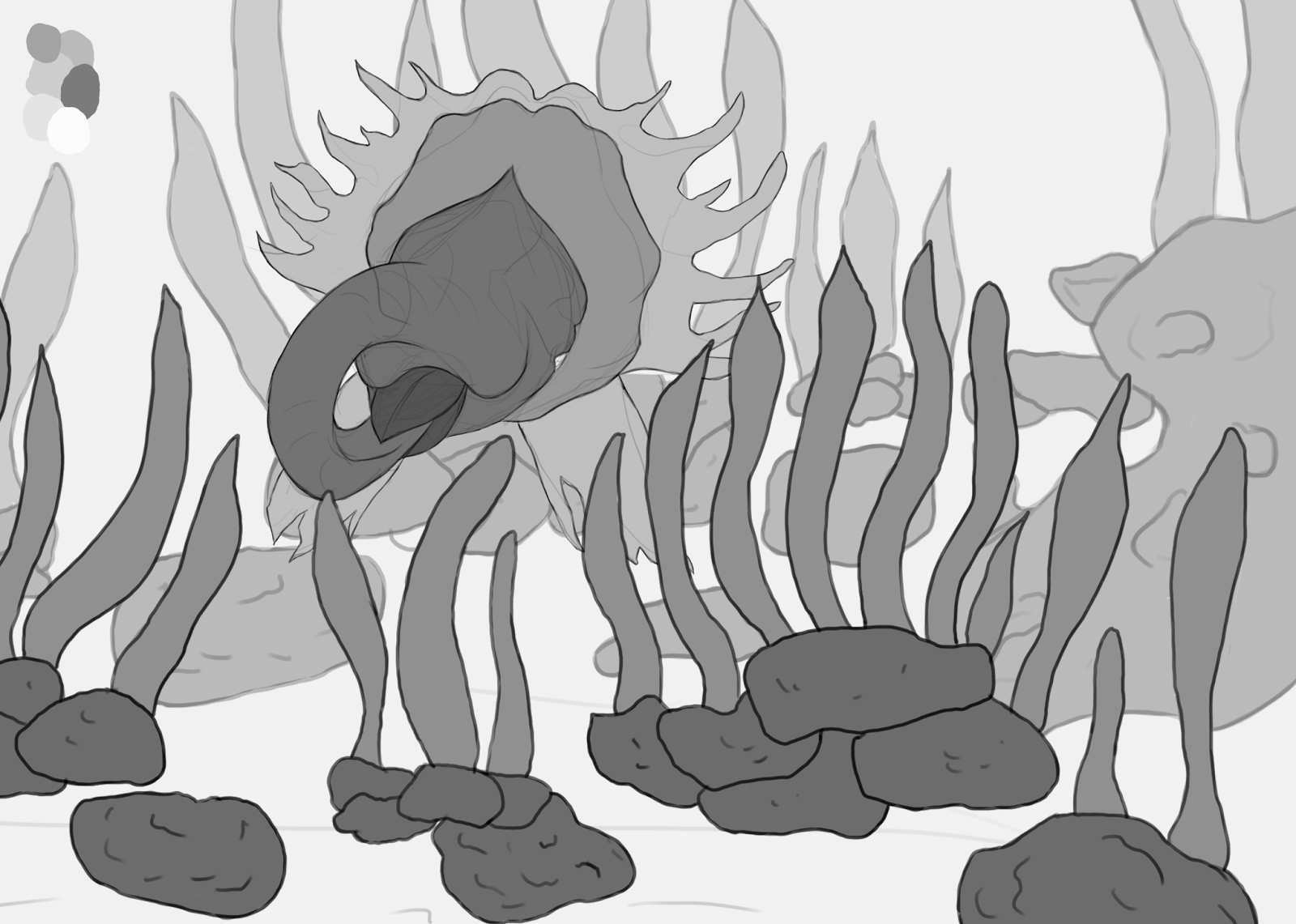
Here you can see how creature 3 uses its tentacle and fins to help blend in with the coral and seaweed. It is also a good position to have as it can easily and quickly grab prey as it swims past this way.

Above you can see that this creature has just caught something; it uses its tentacle to put prey into its beak, almost like an arm. After this, it continues to hunt and puts its tentacle back up ready to grab anything else. This creature will spend most of its life doing this, other than this is hides from predators and once a year, reproduces.


Above is a creature burying its eggs in the sand. They can lay up to 6 eggs and once they are buried, they leave them to fend for themselves. Once they hatch, they swim as fast as they can to the nearest collection of coral where they are safe from predators and they begin to feed on smaller creatures.

My plan after university


I've been thinking a lot on what my plans are after university in terms of my art. I know I'll be moving back home with my parents to help save money for wherever I end up moving to next.

I found a really great course in Australia at Newcastle university, called Natural History Illustration. I could do the 3 year bachelor degree or the 1 year honours. The course studies 3 main subject areas, Art, Science and the environment, leading to specialised careers such as medical illustration, archaeology and environmental conservation. I think this course would really help with my creature design skills as the course teaches students to produce anatomically accurate sketches, studying habitats, drawing from a microscope and lots of field observations and studies. They also do both traditional and digital illustrations.      
However, I researched into tuition fees and for the 1 year Honours course, it's $27,280 which is about £14,500. The only scholarship for that course is only $1,500. Either way, I cannot afford that, so I've emailed the lecturers of the course asking if they have any advice or reading lists for the course. Hopefully they will get back to me.

If I'm not successful with any of the jobs or internships I've applied for, I want to keep studying creature design. I hope to get some freelance work and volunteer at a cat and dog rescue centre down the road from me. In my spare time I'll be doing animal anatomy studies and creating creatures while applying to jobs. I'd take up horse riding again, maybe do some drawings of horses while other lessons are going on. Hopefully promote some freelance work as a lot of parents go to the stables with their kids and ponies, they might want a horse portrait done.   
I also want to look into learning 3D sculpting, creating animals and creatures and improving my skills. Do some life drawing at Belfast Zoo etc. 

Overall, I have a lot of options for after uni which calms me as no matter if I don't get any jobs or internships, I can still use my time at home to practice and improve my skills. 

Supervisor Meeting


With my meeting with Lynn I showed her the final piece to creature 2 and the development sketches I had created so far with creature 3.
For the final piece for creature 2 she suggested that I made the left side of the image darker because there were some rocks in the background that looked like it has as light source. Also that the fireflies could use with more glow because they are getting lost within the image.
For my development sketches for creature 3, she really liked them however she wanted me to develop them some more as from the side view, the body didn't look quite right and the head was too similar to an elephants. Making the whole creature look like I'm taking parts off of real animals and putting them together, which we both know is something that I don't want to end up doing. She suggested to look up more sea creatures such as sea horses and octopuses to study them and develop my sketches even more by playing around with the body shape to support the trunk etc.    


Lynn also had a look at my CV because I was feeling a bit anxious about the layout and whether the images on the whole page is appropriate. She liked them but said that in some places it is hard to read and that if an employer was to print them out it could print out bad - something which I haven't tested out myself.
She gave examples of what other artists created with their CVs such as having a banner on each page with a part of a painting, this is an idea that I really like and when I find the time I'll test it out.

Overall, as always the meeting was really helpful and we will have our next at our usual time on Monday at 1pm.


Job/Internship search and industry experts interviews


While working on my project, I've been applying to some jobs and internships. I found most of them through Linkedin and other companies that I greatly admire. I've been applying to 2D concept art jobs, its difficult to find jobs that are entry level, and ones that are expect 2-3 years of working within the industry. So I believe that internships are my best bet for now, but you never know so I'll keep applying to jobs that I believe I have the right skills for. As of now, I haven't heard anything back and I'll keep applying whenever I have spare time away from my project. 

I also haven't heard anything back from the industry experts that I emailed. There is still a chance that they could email me but now I have to start thinking on different options for my research. Below are the questions that I emailed the industry experts: 

How important is a high understanding of animal anatomy the key to a successful creature designer and why do you think this?

Would you consider any 3D knowledge/skill for a 2D Creature Artist to be beneficial?

How important is Natural History within a creature and why do you think this?

What are the key steps in your creature production pipeline?


How would you personally measure whether a creature design is believable or not?


Tuesday, 15 March 2016

Creature 3: Development Sketches


Above are development sketches of creature 3. This creature has one tentacle at the end of its face that it uses to grab nearby prey; the tentacle has suckers on it, much like an octopus has. This creature does not hunt as such, it hides amongst the coral and seaweed as it camouflages itself by changing the colour of its skin.
To the left of the image you can see an egg, this creature lays eggs and buries them in the sand. They leave the eggs to hatch and fend for themselves; as soon as they hatch, they swim to the closest collection of coral where they are protected.

I need to do quite a bit of research into the different colours octopuses change into and how/why. This is something that I know little about so it'll be interesting to research into.

Friday, 11 March 2016

Creature 3: Inkblot


Here is the start of creature 3. Instead of using the inkblots for inspiration for the whole head, I thought I could make it the whole body. I wanted to make creature 3 a sea creature so I thought that where the inkblot is pushing outwards, that can be fins. The darkest part of the inkblot is the head, it has a long trunk/arm, much like an elephants that it can use to grab prey.
Overall, this is a more complex inkblot, therefore the design is going to take longer and possible more time to develop what it looks like. The other two creatures, it was easy to find anatomy references as they resembled common animals, whereas with this, it's going to be a lot harder because it is a sea creature and I'm not sure whether there is going to be a lot of anatomy studies of similar animals. Either way I think this creature is going to be fun to develop and more of a challenge.