Monday, 15 February 2016

Evolution in Action


“The result of natural selection will not be a species ever more powerful and prolific, but rather a continual adaptation to the changing conditions of life.” Page 97

Evolution takes many forms and affects different species in different ways. Every species is subjected to a number of constraints such as the change in climate or vegetation, or the migration of prey animals. Each of these factors affects every creature in some form, whether it is the change in their size, behaviour or even their diet. A Creature’s main goal within their lives is to reproduce and survive; in difficult situations this can cause an animal to take actions in which is not regular to them. Such as with the sudden early migration of prey animals because of extreme drought in Africa, left the Lions desperate for food. Resulting in them hunting and killing young elephants. This is not typical behaviour as it is extremely dangerous to separate a calf from the herd.
The delegate balance of routine in nature can be incorporated into creature design. The introduction to the main characters could have a dramatic affect on a creature’s behaviour, out of fear it could create aggression towards the characters.  

Parasitism is a behaviour developed by some animals, the definition of a parasitism animal, is an association of two species in which one exploits the other. For example, the Cuckoo bird lays its eggs within another bird’s nest. This other bird takes care of it until the cuckoo egg hatches. The chick then begins to push the other eggs out of the nest, leaving itself for the mother bird to give it undivided care. The host bird never notices the difference in eggs or even chicks as it raises another bird’s offspring. The benefit for the mother Cuckoo is that it does not have the responsibility of parenthood and can focus on its own survival as another bird raises its young.
The Skua is a sea bird that is also parasitic; they attack other sea birds when they have made a catch. Behaviour such as this is a survival tactic; it harasses other birds for their prey. By doing this, the Skua is saving energy by not hunting for its own food; the other bird has to work twice as hard to survive.

Alien creatures could show parasitism behaviour towards humans. Human characters within a film could be the host for the creature to reproduce or to protect them. If characters are busy killing an alien species that is the enemy of another alien, they will become docile for the time being towards humans. The enemy of my enemy is my friend. Once humans have stopped being useful, the creatures could become hostile to them.

“For biologists, the word ‘evolved’ does not carry exactly the same meaning as in ordinary language. Evolution is not necessarily an improvement but simply a transformation.” Page 55

The mandrill’s skull has large fags, bigger than the average omnivores teeth. These massive fangs are not for killing or taking down prey, which is what you would first expect, but for more social reasons. Mandrills use their fangs for scaring off predators and establishing themselves within their social group. An animal may develop specific traits for not the obvious reason, such as these fangs. A creature that looks a certain way is not necessarily because of the obvious reason. A creature with a large collection of tusks and teeth is more likely for fighting each other, rather than taking down prey. For example, the Babirusa is a type of pig that grows two sets of tusks; one set from the mouth and the other on the bridge of the nose. The tusks are used for fighting each other and protecting their face, however if these tusks grow long enough, it will grow through the skull and into the brain, killing them.   

The larger the animal, the more difficult it is surviving, that is the problem with giants. They need large territories for their huge feeding needs and they tend to have structural problems due to their large frame. Large animals live longer but their reproduction rate is slower, and with the large territories, mates tend to be difficult to find. Elephants combat the weight of their huge skull by having many air filled cavities, which reduces its weight without diminishing its strength. This makes it easier to be the size they are by having its weight reduced.
A creature cannot be huge without have multiple structural problems, a large creature are not as agile or fast as one half its size. Even an Elephant cannot jump, at least tweet feet firmly on the ground to support itself.

All images and quotes in this blog post I have scanned/quoted myself from the referenced book below: 


Jean-Baptiste de Panafieu. And Gries P. 2011. Evolution in Action: Natural History through Spectacular Skeletons. Thames & Hudson.

Wednesday, 10 February 2016

Creature 2: Development Sketches


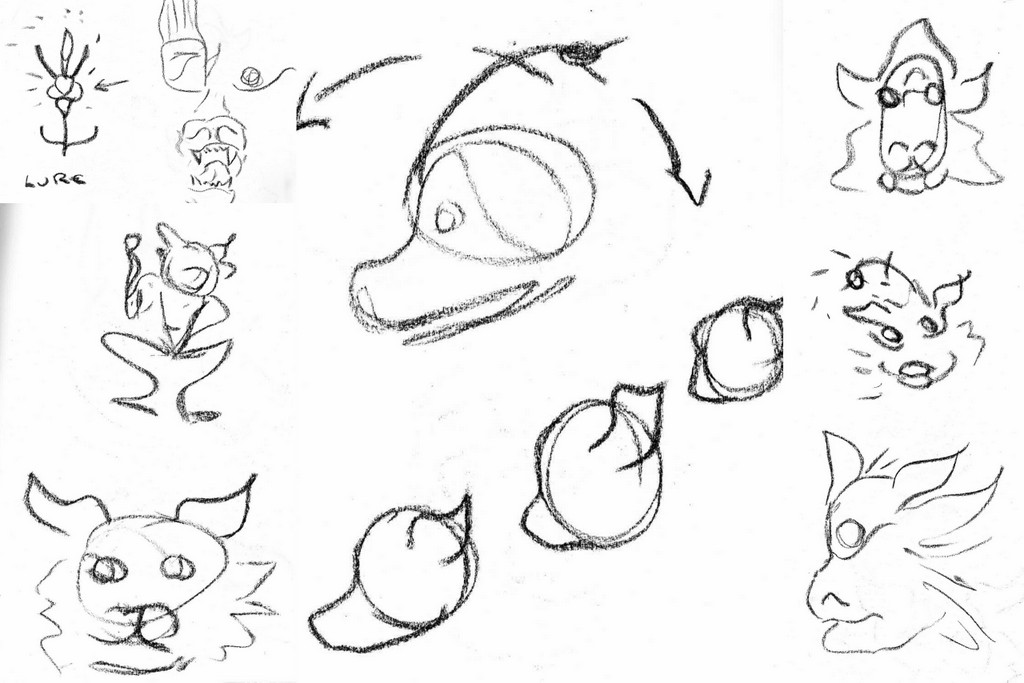
Here are development sketches of creature 2. I imagine this creature to be quite small, about the size of a domestic cat. They are nimble, light and live in a society similar to Meerkats. They live in large family groups with one dominant male and female who are the only ones who have the breeding rights. They live mostly underground to protect their young from other predators, and they hunt in dark underground tunnels and caves, using their lure to help them. They large fangs, like a lot of monkeys and apes, are used for show. They can bare their teeth at each other in aggression or defence.  
At first I thought that they would only live underground where there is no light, thus making them blind. They would use the long hairs on their face like cats whiskers to help them navigate through the cave. Then I began thinking that a mammal would find it almost impossible to survive and raise its young in this kind of environment.
I need to think about this creatures live style more in order to properly create a believable creature.

Sunday, 7 February 2016

Charcoal Sketches: Creature 2


Here are some quick charcoal drawings, mostly figuring out the shape of the creatures head and snout. I'm thinking of a small to medium size monkey, not an ape. I'll be doing research into different kinds of monkeys as I don't know a lot about them let alone how they move and their anatomy. I'll be exploring and developing more in my sketches after doing the monkey research.

Saturday, 6 February 2016

McManus Gallery

Today I went to the McManus gallery to do some sketching of their taxidermy animals. They had a skull of an extinct cow called Aurochs which was twice the size of a cow today. They also had animals like bears, wolves and birds. I did some sketches of the animals that I felt inspired by, I really liked studying the animals that had expressions such as the roaring bear and the howling wolf. I found it difficult to draw snouts like the one on the badger. I find it difficult to draw because snouts are straight and bent at the same time. Its hard to get the angle and perspective right for me. Obviously this is something that I need to commit time to studying and practicing. I do however, like the sketch I drew of the owl, its hard to get the detail and the body shape right for an animal thickly covered in feathers, but I think I did a good job.
Overall, I really enjoyed doing this and I wish I had more time to do this more often. I will try and make a habit of drawing from real life whether its from a taxidermy animal or a pet.
 

Friday, 5 February 2016

Inkblot Creature 2 Development

Here is the initial development for creature 2, the left is the inkblot and the right is my interpretation of it. To me the inkblot looks a lot like a monkey with lots of strands of fair. The top of the head could be a lure much like the lures of creatures in the deepest part of the sea. This creature is a bit more complicated than the last one, and I really have to think and develop it to justify every part of it's anatomy.    


Thursday, 4 February 2016

Meeting with Simone


With my meeting with Simone, we discussed my work so far. She was happy with the work I was producing and gave me some advice on different places for inspiration which were the McManus Gallery, Camperdown Zoo and D'Arcy Thompson Zoology Museum.
We also discussed what I was going to produce for my showcase. My ideas are to have each of the final pieces of each creature printed out and have a book showing the development of each creature. We looked at different printing websites and the one I liked best was Blurb. The others were Moo and Vista Print.
Looking back to my research proposal, the question of "Does practical creature design have an affect on suspension of disbelief?" does not apply to my project as well. the term suspension of disbelief is quite broad, it included story, environment, characters etc. With my project, I only want to focus on the creature design. I need to rethink my question, to focus my project research further as to not get distracted by other aspects of film.

For the next group meeting next thursday, I need to create a new question that better fits my project and to start creating the questions for my interviews.

10 myths about the rule of thirds

Travis Leaf Glover has written a really interesting article on his thoughts about the rule of thirds and how it has impacted him as an artist. He believes that this rule has delayed his growth as an artist and encourages other artists to practice other rules.  
I've never been too sure about the rule of thirds myself, because I always thought your images would all end up looking the same with the character/focus point in the same third every time. However, I thought it was the right thing to do, so I tried to incorporate it into my paintings. Within this article, there mentioned a lot of other composition rules that I haven't even heard of.  
  • Figure Ground Relationship 
  • Law of Continuity 
  • Greatest Area of Contrast 
  • Dynamic Symmetry 
  • Coincidence 
  • Law of Symmetry
  • Radiating Lines
  • Ellipses 
  • Enclosure 
  • Law of Proximity 

All of these laws can help me create rhythm, unity, tension and have the viewers eyes move around my painting. I did notice that when creating my final piece for my first creature, by using the rule of thirds I kept getting unwanted negative space within my painting. Both creatures looked so far away from each other that they didn't look like they were interacting at all. I intend to go back on that painting and see what I can change composition wise using what I've learned through this article.  

All images used for this blog post are from the article. 
Link to the article: http://petapixel.com/2016/01/30/10-myths-about-the-rule-of-thirds/